
Why You Need a Venture Clienting Program
What if you could find startups that are aligned with the problems of your specific business units and define a minimum viable purchase? What if you could also define the proof points you need in a minimum viable experiment instead of in a lengthy pilot project? This is where venture clienting comes in. It redefines the corporate-startup relationship by positioning the corporation as a customer first, not as an investor or a strategic partner.
Corporate innovation is under pressure, with teams being asked to do more with less, keep up with trends, show results faster, and directly engage business units. Traditional internal development teams alone often struggle to keep pace with rapid technology cycles and disruptions in their industries. Even with the rise of vibe coding and fast fashion SaaS, which as tools and methods can boost internal development efforts, startups will, more often than not, adopt these practices faster and will bring solutions to market faster and cheaper than their corporate counterparts.
Accordingly, more companies today are turning to open innovation. The proportion of startup-led corporate innovation has risen dramatically in the last 10 years, with only 5% of corporate leaders identifying startups as a top-three source of innovation in 2015, but with 44% of those same leaders expecting startups to be a top-three source of innovation in 2025.
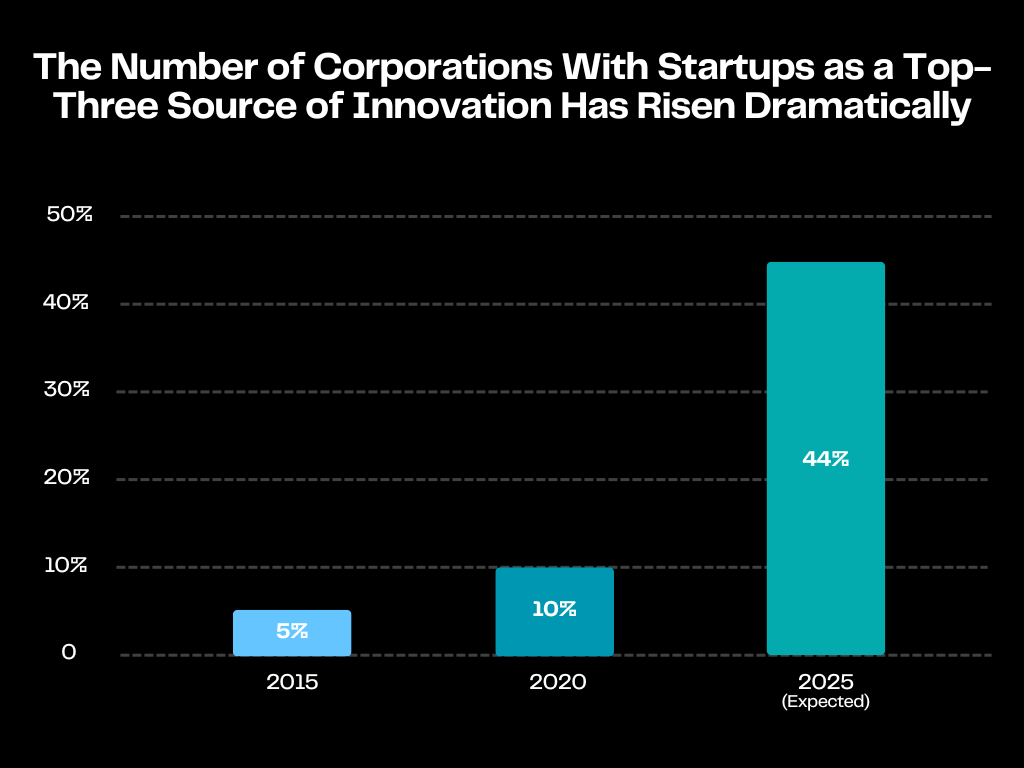
In 2020, corporate leaders were asked to identify the top three sources of innovation five years ago, today, and those expected five years from now. Source: Capgemini/MIT.
There must be a better way. What if you could find startups that are aligned with the problems of your specific business units and define a minimum viable purchase? What if you could also define the proof points you need in a minimum viable experiment, in the form of a simple proof of concept (POC), instead of in a lengthy pilot project?
This is where venture clienting comes in. It redefines the corporate-startup relationship by positioning the company as a customer first, not as an investor or a strategic partner.
This means that you’re no longer doing this:
- Making equity bets upfront, thus confusing the immediate needs of your business units.
- Designing complex partnerships with co-development, IP sharing arrangements, and other entangling endeavors.
- Investing in lengthy pilot projects that define a scope that’s beyond what you need to make decisions today.
Instead, you’re doing this:
- Minimizing administrative barriers to working with startups.
- Defining small-scale purchases and tests that let you learn just enough about a startup’s offering to understand the wisdom of making larger investments later.
- Removing, or at least postponing, any potentially entangling arrangements like investment, partnership, or co-development. (If you’re doing venture clienting right, you will go a long way toward de-risking such future arrangements.)
In doing these things, you’re not only accelerating the adoption of individual ventures, but also building a repeatable pathway for innovation with the potential to scale across the enterprise. By streamlining procurement, aligning VC research rigor with business units, and spreading a culture of experimentation, its benefits extend well beyond the work with individual startups. In the following sections, we’ll look at how venture clienting works through three systemic benefits that shape innovation organizations, and even the enterprise more broadly, more than any single venture engagement does.
Sidestep Procurement Bottlenecks
Traditional procurement processes are designed for stability and risk management with large, established vendors, and rightly so. However, while effective for sourcing known suppliers, these processes are not optimized for working with early-stage startups. Requirements like exhaustive RFPs, vendor registration, compliance checks, and contract negotiations can stretch out over months, and sometimes prevent projects altogether due to strict internal privacy and legal standards. Protracted timeframes can stall innovation at the corporation, and can put startups at risk of insolvency before projects even begin.
Venture clienting can address this gap by creating a dedicated team with the mandate to redesign processes around innovation. This team sits at the intersection of legal, IT, procurement, and business units, but operates separately from traditional processes to create a parallel fast lane process to streamline templates, governance structures, and service levels tailored for startup engagements rather than enterprise-scale vendor contracts that may involve unnecessary complexity and costs.
At ID8, we have seen firsthand how critical this fast lane procurement function is:
- Automotive Sales Partnerships: We designed fast lane documents and processes that allowed an automotive sales organization to embed startup partner offerings directly into the customer journey. What would have once taken months of approvals was transformed into a structured but lightweight process that enabled real market experiments that were optimized for fast, disciplined learning at first before considering enterprise scale.
- Industrial Conglomerate Modernization: Across multiple subsidiaries of a large industrial conglomerate, we helped redesign environmental scanning, opportunity prioritization, and a lean POC framework. This not only clarified how opportunities were identified but also standardized how they moved into rapid POCs. The result was an innovation function that scaled across diverse businesses without collapsing under the weight of complexity, as well as a process that stressed clearly defined proof points obtained with minimal time and capital investments.
- Consumer Electronics Bottlenecks: For a global consumer electronics company, we uncovered that their legal processes, built for high-stakes vendor contracts, were being applied to low stakes innovation pilots. This created friction and delayed critical experiments. By reworking their approach, we reduced approval times significantly and gave innovation teams the freedom to run smaller, faster tests without sacrificing compliance or oversight.
Think Like a VC, Act Like a Business Unit
Venture clienting requires the discipline of venture capital combined with the pragmatism and strategic focus of a business unit. It calls for rigorous sourcing, scanning the market for emerging solutions, and filtering startups through structured evaluation. Unlike venture capital, however, the primary venture clienting goal is not financial gain through the venture but rather through what the venture can do for the business unit strategically. The near-term objective is operational proof, defined narrowly through a minimum viable experiment, which is the venture clienting equivalent of due diligence.
This is where the distinction between minimum viable purchases and minimum viable experiments becomes important. The venture clienting team defines the purchase that keeps procurement simple and light. The business unit defines the concept that makes the proof point meaningful to its priorities. When these two come together, POCs create tangible outcomes without being slowed down by the weight of traditional investment or procurement processes.
Another important feature of venture clienting is that it decouples purchasing from investing. Too often corporate venture capital investments are made in parallel with early partnerships, which can blur the motivations on both sides. Venture clienting allows a company to remain a paying customer first, while reserving the right to invest if there is financial or strategic reason to do so.
Spread Innovative Thinking Across the Enterprise
The ultimate aspiration of many innovation teams is not simply to test new technologies but to influence how the entire organization approaches change. Venture clienting provides a practical way to do this. Because it is structured, repeatable, and closely tied to business unit priorities, it becomes a model that translates well across business units, allowing other teams to understand and replicate them far better than they could more innovation-specific models like venture studio and corporate venture capital.
When business units see legal, IT, and procurement functions working together through a venture clienting framework, they gain a concrete example of how innovation can be managed with discipline but without the delays given the right context. Over time, this can create a halo effect. Functions outside the innovation team begin to adopt similar principles of clarity, speed, and experimentation in their own work. This is why venture clienting often outlives the specific projects it supports. It plants the seeds of innovative thinking across the enterprise, showing teams that agility and discipline can coexist, and that different processes can exist for opportunities that fit different profiles.
Getting started requires enthusiasm for the model and the will to get others on board with its benefits, but it doesn’t stop there. It calls for a deliberate playbook that lays out the full system.
This means:
- Defining the right team composition and its alignment with the innovation organization, business units, and corporate senior leadership.
- Setting a regular cadence, if not a continuous cycle, of environmental scans to identify new opportunities.
- Creating consistent processes for opportunity assessment and prioritization.
- Establishing robust systems for tracking innovation projects of all types, including venture clienting POCs, so that progress is visible and outcomes are measurable.
If you are interested in how to set up this kind of program, or if you simply have questions about venture clienting and how it could apply to your organization, we at ID8 are here to talk.

Will You Be at Innolead Impact 2025?
Connect with us in Boston, October 20-22

Mara Lewis
Co-Founder


Brad Holliday
Co-Founder